One early county burial ground that no longer exists is Crisman Cemetery located in Portage Township. Fortunately, enough fragmented pieces of evidence exist to trace what factors may have led to the abandonment of this burial ground and to identify its most probable location.
With respect to burial information in Porter County, the Northwest Indiana Genealogical Society's cemetery indices provide a wealth of information. The Society's index of Portage Township cemeteries, published in 1995, includes this statement concerning Crisman Cemetery:
With respect to burial information in Porter County, the Northwest Indiana Genealogical Society's cemetery indices provide a wealth of information. The Society's index of Portage Township cemeteries, published in 1995, includes this statement concerning Crisman Cemetery:
Benjamin & Elizabeth (Baughman) Crisman arrived in Porter Co. in 1850. Their family consisted of Solomon, Isaac, Addison, Oliver, Henry, Milton, Haney, Wesley, Eliza, Jane. While excavating for a service station at the SE corner of US 20 in section 1, stones were found. One stone had I. & J. Crisman and another had Wilbur - Martha children of I & J Crisman. Isaac Crisman was born June 3, 1839 and married Jane White on December 12, 1870.The genealogical society's information was probably gleaned from the following article published in the July 11, 1962, issue of The Vidette-Messenger:
Grave QuestionAbout one week after this story was published, the following column appeared in the July 19 issue of The Vidette-Messenger:
By ROLLIE BERNHART
PORTAGE -- Descendants of Portage pioneers, Isaac and Jane Crisman, are currently mulling over a monumental question involving recently unearthed family gravestones.
The three stones -- a family monument and two headstones – were found by workmen at the southeast corner of U.S. 20 and Crisman road during excavations for a new filling station.
Big question to descendants Mrs. Celia (Crisman) Nealon and her sister, Mrs. Max Wheat, was the locale of the family cemetery.
Both Portage women are of the opinion that the family plot was located north of the spot where the stone were found, in an area north of the former Soule restaurant.
Erected By Pioneers
They feel it is impossible to believe that heavily travelled U.S. 20 could now be running through and desecrating the Crisman family graveyard. "If so," they asked, "how was the law evaded involving desecration of graveyards?"
The monument apparently was erected by pioneers Isaac and Jane Crisman, grandparents of Mrs. Nealon and Mrs. Wheat, in memory of two children, Wilbur and Marta, who died in 1876 of scarlet fever at ages of five and three.
Both the monument and headstones are of unpolished marble and in excellent state of preservation. The headstones bore the names of Wilbur and Marta on top.
Mrs. Nealon, who resides north of the highway on Crisman road, said she and her husband found other tombstone markers of the two children when they acquired their present property 20 years ago. She belives [sic] there was a township graveyard extending north or south of U.S. 20 along Crisman road, which may have become neglected and overgrown with weeds and brush prior to construction of the highway in the middle 1920's.
She said she intends to do some research and checking of records at the courthouse in Valparaiso.
Meanwhile, excavators at the filling station site may turn up more evidence of the possible existence of a graveyard.
Isaac Crisman, son of Ben Crisman, who migrated to the Portage area, was reported to have been the township's first trustee and its first postmaster.
Isaac and Jane resided at 355 Crisman road, south of U.S. 20, now occupied by Glenn Hankinson.
Explanation Offered Crisman Grave MysteryExamination of the factual elements mentioned in these companion articles shows that Celia (Crisman) Nealon believed that the Crisman Cemetery was a township cemetery. It is important to note that the term "township cemetery" has a long established legal meaning in Indiana; today, Indiana Code Title 23, Article 14, Chapter 68 provides the legal authority for the care of cemeteries by township trustees.
By ROLLIE BERNHART
PORTAGE -- Any possibilities of the existence of the pioneer Crisman family cemetery at the southeast corner of U. S. 20 and Crisman road in Portage, were dissipated in a report from Mrs. Celia (Crisman) Nealon today.
The question of the family cemetery being located at the intersection arose after workmen two weeks ago unearthed three family gravestones during excavation for filling station at the corner.
Mrs. Maude Blair, 500 Old Porter road, who knows her early Portage history well, aided Mrs. Nealon and her sister, Mrs. Max Wheat, in clearing up the mystery Wednesday.
Mrs. Blair took Mrs. Nealon to a spot north of U. S. 20. directly south of the present Portage Township School administration building and "positively" identified the section where the township cemetery was located, Mrs. Nealon stated.
It is Mrs. Blair's opinion that members of the pioneer Crisman family are still interred there, even though there are no visible stones or markers. The cemetery is located on a high bank overgrown with trees and thick brush.
The mystery of how the three recently unearthed stones, in Wilbur and Marta, son and daughter of I. and J. Crisman, became buried at Crisman road and U. S. 20, still remains unsolved, Mrs. Nealon said today.
The establishment of township cemeteries were rather common during the early history of Indiana. Typically, the family of one of the first individuals to die in a township would bury their family member on or very near the grounds of their homestead. As other individuals passed away in the surrounding area, they would also be interred at this newly established burial ground.

News item and photographs concerning unearthed
tombstones from the Crisman family cemetery.
Source: The Vidette-Messenger, July 11, 1962.
The family owning the burial ground property would very often deed it to the township or county to ensure its perpetual maintenance through the expenditure of township funds. If Crisman Cemetery was an official township cemetery, then the probability that the cemetery land was deeded to Portage Township would be high. We can assume, however, that Crisman Cemetery was never a township cemetery since no recorded deed exists; Delia Nealon's statement about Crisman Cemetery being a township cemetery was purely speculative and can be easily disproven by deed records.
Next, it was thought by Nealon, Wheat, and Blair that the Crisman Cemetery was situated north of U.S. Route 20 along the east side Crisman Road and not at the southeast corner of the intersection of U.S. Route 20 and Crisman Road. Celia Nealon remarked that when she and her husband purchased their property north of U.S. Route 20 around 1942 that they had found on it "other tombstone markers of the two children." Similarly, Maude Blair "'positively' identified" the location of the burial ground, which was north of U.S. Route 20 "on a high bank overgrown with trees and thick brush." A 1948 plat map shows that the location identified by Blair was adjacent to property co-owned at that time by Nealon and Wheat.
The second article concludes with the sentence: "The mystery of how the three recently unearthed stones, in Wilbur and Marta, son and daughter of I. and J. Crisman, became buried at [the southeast intersection of] Crisman road and U. S. 20, still remains unsolved...."
Perhaps the location of the excavated tombstones is not a mystery. It is possible that the tombstones found their way to their discovered location during the construction of U.S. Route 20 in 1931. This particular area is relatively low and somewhat marshy ground and required the installation of a properly engineered drainage system and elevated road bed when U.S. Route 20 was built. The "high bank" where the burial ground was believed to have been situated would have offered a readily available and low cost opportunity for road builders to obtain fill when establishing the road's grade. Thus, heavy earthmoving equipment may have transferred soil, along with the tombstones, from the high bank southward to the location where excavation was taking place in 1962.
A short news item in the July 30, 1962, issue of The Vidette-Messenger somewhat confirms the soil displacement theory mentioning that Axel Tranberg of Portage "is supposed to have seen the edges of coffins as the highway department dug down for U.S. 20 near the Crisman Road intersection. Oldtimers in the area contend the cemetery was located north of the highway and east of Crisman Road."
Published historical information suggests that maybe this obliterated burial ground should not be referred to as Crisman Cemetery, but rather it should be called the Hunter Cemetery or Field Cemetery. The following short news item appeared in the October 19, 1882, issue of the Porter County Vidette published in Valparaiso:

News item stating that Oscar Field refuses any additional burials on his farm.

Notice published by Oscar Field demanding the vacation of
bodies in the burying ground located on his property.

Death notice for child of Ike Crisman.
Collectively, factual information strongly suggests that the Crisman Cemetery was located in the north one-half of the southeast quarter of Section 1; the 1876 plat map of Portage Township indicates that this land was owned by George W. Hunter.
Published historical information suggests that maybe this obliterated burial ground should not be referred to as Crisman Cemetery, but rather it should be called the Hunter Cemetery or Field Cemetery. The following short news item appeared in the October 19, 1882, issue of the Porter County Vidette published in Valparaiso:
Joy's Run.
Fields [sic; Field], who owns the Geo. Hunter farm, refuses to allow any more graves to be dug in the grave yard on his farm and gives notice to have those removed already there. As there is no deed for the lot, his wish will probably he [sic; be] complied with.

News item stating that Oscar Field refuses any additional burials on his farm.
Source: Porter County Vidette, October 19, 1882.
Over the next following four weeks in the October 26 and November 2, 9, and 16, 1882, issues of the Porter County Vidette, a formal public notice was published by Oscar Field demanding that bodies be removed from his property.

Notice published by Oscar Field demanding the vacation of
bodies in the burying ground located on his property.
Source: Porter County Vidette, October 26, 1882.
Approximately six years prior to the publication of the Oscar Field's demand for the removal of bodies from his property, a news item appeared in the Porter County Vidette's December 7, 1876, issue announcing the death of one of Ike Crisman's children due to scarlet fever and another being at the "point of death;" these two children would have been Wilbur and Martha Crisman whose tombstones were shown in a photograph with the July 11, 1962, article published by The Vidette-Messenger.

Death notice for child of Ike Crisman.
Source: Porter County Vidette, December 7, 1876.

Portion of Portage Township plat map showing location
of George W. Hunter's property in Section 1.
Source: Hardesty's 1876 Illustrated Historical Atlas of Porter County, Indiana, p. 67.

Photograph of George Wesley Hunter.
Source: Dianne Goshorn, Ancestry.com.
Interestingly, despite Oscar Field's notice to have human remains vacated from his property in 1882, the death notice for Elizabeth Crisman published on December 20, 1888, in The Tribune (Chesterton) states that Elizabeth was "buried in the Oscar Field cemetery." Thus, this burial ground was still in use as late as December 1888. Field had died in February of 1888, so area residents continued to use his property for burials while his estate was proceeding through probate.

Death notice for Elizabeth Crisman.
Source: The Tribune, December 20, 1888.
That said, Elizabeth Crisman may have been rightfully buried, in a legal sense, at the "Oscar Field cemetery" as a direct result of an 1883 court case whereby Benjamin Crisman, Isaac Crisman, and Joseph White, plaintiffs, challenged Oscar Field and Jane Field, defendants, from denying burials on the Field property. The decision in this case was in favor of the plaintiffs with a decree of a perpetual injunction. Given the decision of this case, the burial ground should legally exist to the present day, though not under deed to Portage Township.

Perpetual injunction against Oscar and Jane Field, most
likely in reference to burials on their property.
Source: Porter County Vidette, June 28, 1883.
So who was Oscar Field who became the owner of George W. Hunter's land and, as a result, ended up having a burial ground appurtenant to his property? Oscar was born on September 17, 1835, in Seneca, Lenawee County, Michigan. It should be noted that other contemporary Oscar Field biographies place his nativity at Adrian, Lenawee County, Michigan, and Saratoga, Saratoga County, New York. Oscar was a son of Reuben G. and Abigail (Strong) Field.
Soon after his birth Oscar moved with his parents to Troy, Rensselaer County, New York, where his mother would pass away when he was a year old. At the age of twelve, Oscar's father died and he would soon travel to Milwaukee, Milwaukee County, Wisconsin, with a total of three cents in his possession upon arrival. Oscar reportedly met a farmer in a tavern a few miles west of Milwaukee and, by chance, learned he was a friend of his now-deceased father, Reuben. The farmer offered Field a job at his farm situated thirty miles west of Milwaukee, which Oscar accepted, and there he became a farm hand for several years.
Soon after his birth Oscar moved with his parents to Troy, Rensselaer County, New York, where his mother would pass away when he was a year old. At the age of twelve, Oscar's father died and he would soon travel to Milwaukee, Milwaukee County, Wisconsin, with a total of three cents in his possession upon arrival. Oscar reportedly met a farmer in a tavern a few miles west of Milwaukee and, by chance, learned he was a friend of his now-deceased father, Reuben. The farmer offered Field a job at his farm situated thirty miles west of Milwaukee, which Oscar accepted, and there he became a farm hand for several years.
Field's obituary mentions that when still a boy he went to the plains and entered the service of the Overland Stage Company where he would eventually rise to be a superintendent of a division of that firm. He moved to Chicago in 1860 where he purchased Ed Price's livery business. In 1865, Oscar married Mrs. Jennie Stokes, the widow of Charles Stokes. Field's livery business would be completely destroyed by the Great Chicago Fire in 1871 and he would rebuild his business only to have it destroyed by another fire in 1874. Once again, he would resurrect his business, this time at 165-166 Michigan Avenue, two blocks south of the Chicago River in today's downtown core.
An 1886 published biography of Field remarks that:
For many years he has been one of the largest shippers of racers and fancy stock in the country, enjoying the patronage of many of the largest horse-owners.... Mr. Field is the owner of the well-known stock-farm at Crissman, thirty-two miles from the city. It contains five hundred and fifty acres, and is supplied with large barns for stock with box-stalls, etc., sheds, water, and shade.It is believed that Field purchased the Hunter property in the fall of 1882, which he would name Pleasant View Farm. The following news item appears in the January 11, 1883, issue of the Porter County Vidette and described Oscar Field's real estate investment in Portage Township:
There is located near Crissman Station one of the largest stock farms in this part of the country. Mr. Oscar Field, of Chicago, a large dealer in and breeder of stock, has purchased about 40 acres of land near the above place and laying out considerable money in making it second to none in the country. He has already 50 head of stock on hand, among which are six head of horses valued at $12,000.Not only was Field purchasing real estate, he was also improving it. It is known from a short news item appearing in the October 1, 1884, issue of Chesterton's newspaper, The Tribune, that Field had been investing in repairs and remodeling on his Pleasant View Farms property:
CRISMAN ITEMS.
Mr. Oscar Fields [sic], owner of "Pleasant View Farms," has been for several years doing a vast amount of repairing on his farm. At the present writing he is remodling [sic] his dwelling house, which when finished, will look very neat and sensible and add greatly to the value of the farm.

Advertisement for assorted goods and stock at Oscar Field's
Pleasant View Farm located in Portage Township.
Source: Porter County Vidette, November 16, 1882.
Field had added considerably to his forty acre parcel purchased from Hunter in the fall of 1882. By 1886 his real estate holdings near Crisman consisted of five hundred and fifty acres. The January 8, 1885, issue of The Tribune mentions that Field was preparing to construct "a mammoth barn on his farm" with a footprint of 40 feet by 250 feet, allegedly making it the largest barn in Indiana at that time. Field also sold sand from Crisman, advertising in The Chicago Tribune; he used the Michigan Central Railroad as the mode of shipment of sand from Crisman to Chicago markets.
Arthur J. Bowser, longtime publisher of the Chesterton Tribune, mentions in the December 24, 1884, issue of his newspaper a visit that Field had at Bowser's newspaper office. Bowser provides a description of Field as follows:
Arthur J. Bowser, longtime publisher of the Chesterton Tribune, mentions in the December 24, 1884, issue of his newspaper a visit that Field had at Bowser's newspaper office. Bowser provides a description of Field as follows:
Mr. Oscar Field, of Pleasant View Farm, Crissman, called at our sanctum last Friday [December 19], and when we say that he made us a pleasant call, we will emphasize that remark by adding that he ordered THE TRIBUNE sent to his address for one year, and also left an "ad" which, the way, we call your attention to. In Mr. Field, we found one of those great big-hearted, jovial democrats who are always looking on the bright side of life, eccentric in some things maybe but at the same time full of enthusiasm for the "forlorn hope."Mr. Field was apparently benevolent and kind. The January 1, 1885, issue of The Tribune states in separate news items that:
On the 28th of the present month, Oscar Field, of the Pleasant View Farm also owner of several large livery-barns in Chicago, will give the orphans of the Orphan's Home, of that city a grand sleigh-ride free of cost. Mr. Fields does this every year, and there is not an orphan in the Orphan's Home but what calls him "uncle."
Last week's issue of THE TRIBUNE gave our fellow-townsman, Oscar Field, owner of the Pleasant View Farm, a generous puff. It is not our intention to write the gentleman's biography, which undoubtedly would be very interesting as well as instructive reading. Mr. Field's life has been a very active as well as eventful one. The fire-fiend has twice robbed him of all his wealth. He lost every dollar in the Chicago fire of '71, yet undaunted he strove again adversity and to-day he is the possessor of thousands, which he distributes with lavish hand on his Porter County home. Besides he furnishes scores of men with employment, who are well paid and the proceeds go toward building and happy homes. The needy man, if honest, never was dismissed without receiving pecuniary aid, and in many instances, profitable employment. A visit to his farm will convince the most skeptical sour milk and codfish aristocrat in Porter County that a man of great wealth can be a prince, and yet be respected by all who known him. Mr. Field is fully aware of the fact that there are millions of people on God's green earth besides himself, who are entitled to a chance of becoming independent, consequently he considers it his duty to make business lively so far as lays in his power. To make a long story short, such men make our world a fit place to live in -- they are the levers that move every branch of industry -- their presence in a community causes business to boom, and elects democratic presidents. In this instance the heart is the power that moves the brain.
At some point Oscar must have moved to reside in Porter County's Portage Township since he would be appointed to serve as the postmaster of the small community of Crisman beginning on May 21, 1886. He served as postmaster until his death although he had moved back to Chicago about a year after his appointment to the position.

Oscar Field advertisement for sale of stock and breeding services.
Source: The Tribune, May 20, 1886.

News item mentioning Oscar Field's appointment to serve as postmaster of Crisman.
Source: The Tribune, May 27, 1886.
Less than a year into his term as the postmaster of Crisman, however, a column critical of Field's management of the Crisman post office appeared in the December 23, 1886, issue of The Tribune. The column states that Field had appointed "a bigoted, narrow-minded republican. By his acts he has brought down the displeasure of the major portion of the patrons of the office, regardless of party and is regarded as a nuisance generally. The Crismanites, in their own language say 'they will not be brow-beaten out of the constitutional right of mailing their letters where they please, by this Mr. Cobb,' and say that his attitude toward them compels them to mail their letters on the train. Great complaint comes from Crisman about this Mr. Cobb, and now Postmaster Field, if you have such a critter in your employ, fire him. Yes, fire him for the good of the cause."

News column critical of Oscar Field's management of the Crisman post office.
Source: The Tribune, December 23, 1886.
Oscar passed away at his Chicago residence located in the Pullman Building on February 12, 1888, and his funeral took place from his home on February 15. He was interred in Chicago's Graceland Cemetery. Oscar had been ill one year prior to his death and he had undergone two surgeries, the second of which reportedly resulted in his death. At his death, Field's estate was estimated to be worth at least $50,000 (or approximately $1.5 million in 2022). Oscar bequeathed his entire estate to his wife, Jennie, and no children are mentioned in his will.

Oscar Field's obituary.
Source: The Chicago Tribune, February 13, 1888.

Notice of Shepard Sargent being appointed Crisman's
postmaster upon the death of Oscar Field.
postmaster upon the death of Oscar Field.
Source: The Tribune, May 10, 1888.
After Oscar's death, his wife Jennie S. Field would settle up his estate. She disposed all the personal property located on Field's Portage Township real estate, consisting of six parcels of land, at a public sale on September 15, 1888. Remarkably, a short item appearing in the January 31, 1889, issue of The Tribune states that Jennie had been ordered [by the probate court] "to settle estate as insolvent," strongly suggesting that Oscar had accrued debts in excess of his assets at the time of his death. Jennie was leasing Oscar's real estate as pasture land in the spring of 1891, advertising its availability in multiple issues of The Tribune. For over a decade, nothing would be mentioned of in local newspapers about the Field property. A short news item, however, appeared in the March 7, 1902, issue of The Chesterton Tribune stating that "There will be a change in the Oscar Field farm at Crisman this spring. Mr. Spencer will retire, and is succeeded by Mr. Detlow. Judge Johnston, who manages the farm for Mrs. Field in her absence, announces that extensive improvements will be made of the farm this year, to cost about $2,000. This is one of the finest farms in the county, and ideally located for extensive stock raising."

Public sale notice placed by Jennie S. Field for
sale of personal property of Oscar Field at Crisman.
Source: The Tribune, August 16, 1888.

Advertisement placed by Jennie S. Field for pasture land at Crisman.
Source: The Tribune, March 5, 1891.

News item concerning the Oscar Field farm.
Source: The Chesterton Tribune, March 7, 1902.
A total of three burials are known to have been made in Crisman Cemetery. Siblings Martha and Wilbur Crisman were buried in the cemetery in 1876 after succumbing to scarlet fever. Elizabeth (Baughman) Crisman, according to her death notice, was interred in the "Oscar Field cemetery" after dying from typhus fever in 1888. Confusingly, a tombstone for Elizabeth exists in Portage Township's McCool Cemetery, suggesting that Elizabeth may never have been buried at the Crisman Cemetery or that her remains were disinterred from Crisman Cemetery and then reburied at the McCool Cemetery. The parents of Martha and Wilbur Crisman - Isaac Crisman and Jane (White) Crisman - are also buried at McCool Cemetery.

Aerial view showing probable location of Crisman Cemetery.
Source: Google Earth, 2021.

Newspaper photograph showing corner where Crisman Cemetery was likely
located northeast of the intersection of Crisman Road and U.S Route 20.
located northeast of the intersection of Crisman Road and U.S Route 20.
Source: The Vidette-Messenger, January 28, 1960.
Why did the Crisman Cemetery essentially disappear given a perpetual injunction existed, thereby ordering for the allowance of burials to continue on the Field property? It is assumed that the decree ran with the land, similar to an easement, and not with the owner of the land. Thus, all successors in interest to the Field property would have been subject to the decree allowing burials.
The fact that Crisman Cemetery did not become a township cemetery likely led to its "disappearance." The cemetery probably served only the White and Crisman families. As these families either removed from Porter County or were buried elsewhere within the county, there was nobody to fill the void in maintaining the cemetery. If the cemetery had been deeded to the township, then it would have become the legal duty of the township trustee to maintain the burial ground using property taxes paid by township landowners.
In addition, the cemetery was located on a ridge surrounded by marsh-like land; control of the overgrowth of herbaceous plants, shrubs, and trees would have to be regularly attended to so as to have the cemetery appear as a properly maintained burial ground. As the cemetery became overgrown, it may have become out of sight and, therefore, an out of mind burial ground. The James-Shrock Cemetery, also situated in Portage Township, is an example of cemetery that was once massively overgrown and nearly "lost" until rediscovered when the Indiana Toll Road was being surveyed for construction through the township.
There is one final twist to this physical site. William Albert Briggs, an early twentieth century historian of Porter County, identified the location of the Crisman Cemetery as also being the location of a house used for the Underground Railroad. Dorris et al., citing Briggs as their source, write in 1976 that "For many years before the Civil War numerous slaves escaped from their masters in the South and made their way northward through the Free States.... Porter County had several lines of this means of escape and one stopping place was located about a half mile from the village of Crisman. It was on the north-east corner of Crisman Road and U.S. 20. Here a frame building of four rooms was built in 1857 by a Mr. Smith who used it as a home for himself and his family. The real purpose of the house was to aid the runaway slaves in their break for freedom. Mr. Smith disappeared and no trace of who financed him, where he came from, or where he went have ever been learned. Two main rooms of this house were built over a double cellar and in the floor of each room was a trap door. One or the other was always covered with a rag carpet. Each door led to a separate compartment of the cellar."
Inspection of the 1860 Federal census records for Portage Township reveal only two Smith families, spelled Smithe, residing in the township, that being the household of John and Pheba A. Smithe and their immediate neighbors Dexter and Caroline Smithe. Interestingly, and consistent with Brigg's observation, neither of these two Smithe families are residing in Porter County according to 1870 Federal census records.
Efforts to determine the current location of the three tombstones discovered in the 1962 excavation have been unsuccessful. The author would be interested if you know anything about these tombstones; please contact him at shookgenealogy@gmail.com.
Below is information concerning the three known burials in Crisman Cemetery.
CRISMAN, Elizabeth Baughman
Birth: August 16, 1816, in Carroll County, Ohio
Death: December 15, 1888, in Crisman, Porter County, Indiana
Note: Wife of Benjamin G. Crisman; tombstone for Elizabeth (Baughman) Crisman appears in the McCool Cemetery in Portage Township. The following death notice published on December 20, 1888, in The Tribune (Chesterton) for Elizabeth Crisman:
DIED- On Dec 15, Mrs. Elizabeth Crisman, of Typhus fever. The funeral took place on the 17th inst., and the remains buried in the Oscar Field cemetery. Mrs. Crisman was the wife of Benjamin Crisman and was an old settler of Porter county, having come to the county with her husband in 1850. Her home was at Crisman Station.CRISMAN, Martha
Birth:
Death: December 1876
Note: Daughter of Isaac and Jane (White) Crisman; given name may have been Mertie.
CRISMAN, Wilbur F.
Birth:
Death: December 1876
Note: Son of Isaac and Jane (White) Crisman; given name may have been spelled as Wilber.
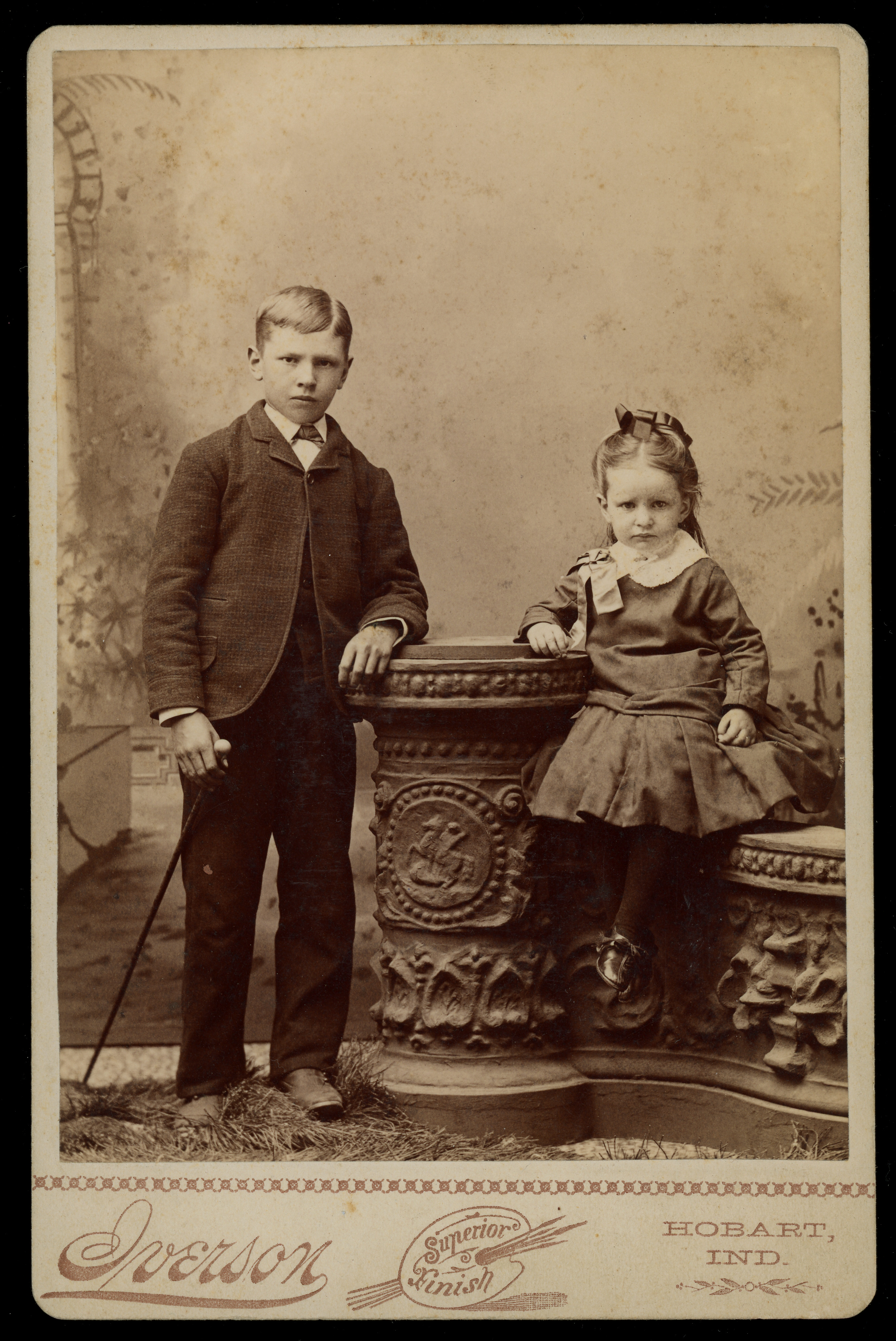
Siblings Burten Allen "Ollie" Crisman and Lucy Mae "Mazie" Crisman, circa 1886.
Two children of Isaac and Jane (White) Crisman that lived to adulthood.
Two children of Isaac and Jane (White) Crisman that lived to adulthood.
Source: Collection of Steven R. Shook.

Isaac "Ike" Crisman, circa 1890s.
Source: Collection of Steven R. Shook.
Source Material
Books
Andreas, A. T. 1886. History of Chicago from the Earliest Period to the Present Time. Chicago, Illinois: The A. T. Andreas Company. 875 p. [see pp. 363-364]
Baker, J. David. 1976. The Postal History of Indiana. Volume II. Louisville, Kentucky: Leonard H. Hartmann, Philatelic Bibliopole. 1,061 p. [see p. 920]
Dorris, Joyce, Dina Vinzani, Dorothy Dudenski, K. Imogene Jones, and James Milligan. 1976. Weaving the Past into the Future: Bicentennial Handbook of Portage Township. Portage, Indiana: Graphic Communications Center, Portage Township Schools. 24 p. [see p. 4]
Hardesty, A. G. 1876. Illustrated Historical Atlas of Porter County, Indiana. Valparaiso, Indiana: A. G. Hardesty. 90 p. [see p. 67]
Historical Publishing Company. 1886. Origin, Growth, and Usefulness of the Chicago Board of Trade: Its Leading Members, and Representative Business Men in Other Branches of Trade. New Yok, New York. Historical Publishing Company. 421 p. [see p. 376]
Northwest Indiana Genealogical Society. 1995. Portage Township Cemeteries. Valparaiso, Indiana: Northwest Indiana Genealogical Society.
Porter County Circuit Court. 1887. Will Record, Volume C, October 1886 to December 1896. Valparaiso, Indiana: Porter County Circuit Court. pp. 80-86 [Will Record No. 622].
Stacy-Ray Map Publishers. 1948. Stacy-Ray Farm Plat Book of Porter County, Indiana. Kankakee, Illinois: Stacy-Ray Map Publishers. 21 p.
Newspapers (listed by date of publication)
Porter County Vidette, Valparaiso, Porter County, Indiana; December 7, 1876; Volume 20, Number 49, Page 3, Column 6. Column titled "Joy's Run Items."
Porter County Vidette, Valparaiso, Porter County, Indiana; October 19, 1882; Volume 26, Number 42, Page 8, Column 2. Column titled "The County. Joy's Run."
Porter County Vidette, Valparaiso, Porter County, Indiana; October 26, 1882; Volume 26, Number 43, Page 5, Column 5. Column titled "Notice To Vacate Burying Ground."
Porter County Vidette, Valparaiso, Porter County, Indiana; November 2, 1882; Volume 26, Number 44, Page 5, Column 3. Column titled "Notice To Vacate Burying Ground."
Porter County Vidette, Valparaiso, Porter County, Indiana; November 9, 1882; Volume 26, Number 45, Page 5, Column 5. Column titled "Notice To Vacate Burying Ground."
Porter County Vidette, Valparaiso, Porter County, Indiana; November 16, 1882; Volume 26, Number 46, Page 4, Column 5. Column titled "Notice. For Sale at Pleasant View Farm."
Porter County Vidette, Valparaiso, Porter County, Indiana; November 16, 1882; Volume 26, Number 46, Page 8, Column 6. Column titled "Notice To Vacate Burying Ground."
Porter County Vidette, Valparaiso, Porter County, Indiana; November 23, 1882; Volume 26, Number 47, Page 4, Column 5. Column titled "Notice. For Sale at Pleasant View Farm."
Porter County Vidette, Valparaiso, Porter County, Indiana; November 23, 1882; Volume 26, Number 47, Page 8, Column 6. Column titled "Notice To Vacate Burying Ground."
Porter County Vidette, Valparaiso, Porter County, Indiana; December 21, 1882; Volume 26, Number 51, Page 7, Column 6. Column titled "Notice To Vacate Burying Ground."
Porter County Vidette, Valparaiso, Porter County, Indiana; December 28, 1882; Volume 26, Number 52, Page 5, Column 5. Column titled "Notice. For Sale at Pleasant View Farm."
Porter County Vidette, Valparaiso, Porter County, Indiana; January 11, 1883; Volume 27, Number 2, Page 5, Column 2.
Porter County Vidette, Valparaiso, Porter County, Indiana; March 1, 1883; Volume 27, Number 9, Page 1, Column 3. Column titled "The County. Joy's Run."
Porter County Vidette, Valparaiso, Porter County, Indiana; June 28, 1883; Volume 27, Number 26, Page 1, Column 4. Column titled "Circuit Court."
Hardesty, A. G. 1876. Illustrated Historical Atlas of Porter County, Indiana. Valparaiso, Indiana: A. G. Hardesty. 90 p. [see p. 67]
Historical Publishing Company. 1886. Origin, Growth, and Usefulness of the Chicago Board of Trade: Its Leading Members, and Representative Business Men in Other Branches of Trade. New Yok, New York. Historical Publishing Company. 421 p. [see p. 376]
Northwest Indiana Genealogical Society. 1995. Portage Township Cemeteries. Valparaiso, Indiana: Northwest Indiana Genealogical Society.
Porter County Circuit Court. 1887. Will Record, Volume C, October 1886 to December 1896. Valparaiso, Indiana: Porter County Circuit Court. pp. 80-86 [Will Record No. 622].
Stacy-Ray Map Publishers. 1948. Stacy-Ray Farm Plat Book of Porter County, Indiana. Kankakee, Illinois: Stacy-Ray Map Publishers. 21 p.
Newspapers (listed by date of publication)
Porter County Vidette, Valparaiso, Porter County, Indiana; December 7, 1876; Volume 20, Number 49, Page 3, Column 6. Column titled "Joy's Run Items."
Porter County Vidette, Valparaiso, Porter County, Indiana; October 19, 1882; Volume 26, Number 42, Page 8, Column 2. Column titled "The County. Joy's Run."
Porter County Vidette, Valparaiso, Porter County, Indiana; October 26, 1882; Volume 26, Number 43, Page 5, Column 5. Column titled "Notice To Vacate Burying Ground."
Porter County Vidette, Valparaiso, Porter County, Indiana; November 2, 1882; Volume 26, Number 44, Page 5, Column 3. Column titled "Notice To Vacate Burying Ground."
Porter County Vidette, Valparaiso, Porter County, Indiana; November 9, 1882; Volume 26, Number 45, Page 5, Column 5. Column titled "Notice To Vacate Burying Ground."
Porter County Vidette, Valparaiso, Porter County, Indiana; November 16, 1882; Volume 26, Number 46, Page 4, Column 5. Column titled "Notice. For Sale at Pleasant View Farm."
Porter County Vidette, Valparaiso, Porter County, Indiana; November 16, 1882; Volume 26, Number 46, Page 8, Column 6. Column titled "Notice To Vacate Burying Ground."
Porter County Vidette, Valparaiso, Porter County, Indiana; November 23, 1882; Volume 26, Number 47, Page 4, Column 5. Column titled "Notice. For Sale at Pleasant View Farm."
Porter County Vidette, Valparaiso, Porter County, Indiana; November 23, 1882; Volume 26, Number 47, Page 8, Column 6. Column titled "Notice To Vacate Burying Ground."
Porter County Vidette, Valparaiso, Porter County, Indiana; December 21, 1882; Volume 26, Number 51, Page 7, Column 6. Column titled "Notice To Vacate Burying Ground."
Porter County Vidette, Valparaiso, Porter County, Indiana; December 28, 1882; Volume 26, Number 52, Page 5, Column 5. Column titled "Notice. For Sale at Pleasant View Farm."
Porter County Vidette, Valparaiso, Porter County, Indiana; January 11, 1883; Volume 27, Number 2, Page 5, Column 2.
Porter County Vidette, Valparaiso, Porter County, Indiana; March 1, 1883; Volume 27, Number 9, Page 1, Column 3. Column titled "The County. Joy's Run."
Porter County Vidette, Valparaiso, Porter County, Indiana; June 28, 1883; Volume 27, Number 26, Page 1, Column 4. Column titled "Circuit Court."
The Tribune, Chesterton, Porter County, Indiana; October 1, 1884; Volume 1, Number 27, Page 1, Column 3. Column titled "Crisman Items."
The Tribune, Chesterton, Porter County, Indiana; December 24, 1884; Volume 1, Number 39, Page 5, Column 5. Column titled "Chesterton Local Items."
The Tribune, Chesterton, Porter County, Indiana; December 24, 1884; Volume 1, Number 39, Page 8, Column 3. Advertisement for Pleasant View Farm.
The Tribune, Chesterton, Porter County, Indiana; December 24, 1884; Volume 1, Number 39, Page 8, Column 3. Advertisement for Pleasant View Farm.
The Tribune, Chesterton, Porter County, Indiana; January 1, 1885; Volume 1, Number 40, Page 8, Columns 1-2. Column titled "Country News As Dished Up by Our Special Correspondents. Crisman."
The Tribune, Chesterton, Porter County, Indiana; January 8, 1885; Volume 1, Number 41, Page 8, Column 1.
The Tribune, Chesterton, Porter County, Indiana; July 9, 1885; Volume 2, Number 15, Page 1, Column 8.
Porter County Vidette, Valparaiso, Porter County, Indiana; August 20, 1885; Volume 29, Number 34, Page 5, Column 3. Column titled "Monday."
The Tribune, Chesterton, Porter County, Indiana; May 6, 1886; Volume 3, Number 6, Page 1, Column 5.
The Tribune, Chesterton, Porter County, Indiana; May 20, 1886; Volume 3, Number 8, Page 4, Column 6. Advertisement for "Pleasant View Farm."
The Tribune, Chesterton, Porter County, Indiana; May 27, 1886; Volume 3, Number 9, Page 1, Column 6.
The Tribune, Chesterton, Porter County, Indiana; December 23, 1886; Volume 3, Number 38, Page 1, Column 3.
The Chicago Tribune, Chicago, Cook County, Indiana; July 31, 1887; Volume 47, Page 13, Column 6. Column titled "Business Chances."
The Chicago Tribune, Chicago, Cook County, Illinois; February 13, 1888; Volume 48, Page 3, Column 2. Column titled "The Obituary Record. Oscar Field."
The Daily Inter Ocean, Chicago, Cook County, Indiana; February 15, 1888; Volume 16, Number 325, Part I, Page 8, Column 2. Column titled "Deaths."
The Chicago Tribune, Chicago, Cook County, Indiana; July 31, 1887; Volume 47, Page 13, Column 6. Column titled "Business Chances."
The Chicago Tribune, Chicago, Cook County, Illinois; February 13, 1888; Volume 48, Page 3, Column 2. Column titled "The Obituary Record. Oscar Field."
The Daily Inter Ocean, Chicago, Cook County, Indiana; February 15, 1888; Volume 16, Number 325, Part I, Page 8, Column 2. Column titled "Deaths."
St. Paul Daily Globe, St. Paul, Ramsey County, Minnesota; February 15, 1888; Volume 10, Number 46, Page 1 , Column 6. column titled "Oscar Field Dead."
Daily Journal, Evansville, Vanderburgh County, Indiana; February 16, 1888; Page 8, Column 4. Column titled "Telegraphic Brevities."
Daily Journal, Evansville, Vanderburgh County, Indiana; February 16, 1888; Page 8, Column 4. Column titled "Telegraphic Brevities."
The Tribune, Chesterton, Porter County, Indiana; March 1, 1888; Volume 4, Number 46, Page 1, Column 7. Column titled "Country News. As Dished Up by Our Correspondents. Crisman Items."
The Tribune, Chesterton, Porter County, Indiana; April 12, 1888; Volume 4, Number 52, Page 4, Column 3.
The Tribune, Chesterton, Porter County, Indiana; April 26, 1888; Volume 5, Number 2, Page 1, Column 7. Column titled "Crisman Salad."
The Tribune, Chesterton, Porter County, Indiana; May 10, 1888; Volume 5, Number 4, Page 1, Column 7. Column titled "Husks and Nubbins. Items Gathered From a Varied Source By Our Huskers. Crisman."
The Tribune, Chesterton, Porter County, Indiana; August 16, 1888; Volume 5, Number 18, Page 4, Column 2.
The Tribune, Chesterton, Porter County, Indiana; August 16, 1888; Volume 5, Number 18, Page 4, Column 8. Notice of "Public Sale."
The Tribune, Chesterton, Porter County, Indiana; December 20, 1888; Volume 5, Number 36, Page 1, Column 6. Column titled "Newsy Nuggets. Culled From All Sources."
The Tribune, Chesterton, Porter County, Indiana; December 20, 1888; Volume 5, Number 36, Page 1, Column 6. Column titled "Newsy Nuggets. Culled From All Sources."
The Tribune, Chesterton, Porter County, Indiana; January 24, 1889; Volume 5, Number 41, Page 1, Column 5. Column titled "Court Notes."
The Tribune, Chesterton, Porter County, Indiana; January 31, 1889; Volume 5, Number 42, Page 1, Column 5. Column titled "Courting."
The Tribune, Chesterton, Porter County, Indiana; March 21, 1889; Volume 5, Number 48, Page 1, Column 8.
The Tribune, Chesterton, Porter County, Indiana; August 29, 1889; Volume 6, Number 20, Page 1, Column 7. Column titled "Notice."
The Tribune, Chesterton, Porter County, Indiana; March 5, 1891; Volume 7, Number 47, Page 8, Column 3. Advertisement titled "Pasture Land."
The Chesterton Tribune, Chesterton, Porter County, Indiana; March 7, 1902; Volume 18, Number 48, Page 5, Column 3. Column titled "Chesterton Chips."
The Vidette-Messenger, Valparaiso, Porter County, Indiana; May 14, 1929; Volume 2, Page 7, Columns 6-8. Photograph column titled "Non-Resident Notice."
The Vidette-Messenger, Valparaiso, Porter County, Indiana; January 28, 1960; Volume 33, Number 174, Page 1, Columns 1-3. Photograph column titled "Portage Corner Brings $75,000."
The Vidette-Messenger, Valparaiso, Porter County, Indiana; July 11, 1962; Volume 36, Number 6, Page 1, Columns 1-3 and Page 6, Column 6. Column titled "Grave Question," by Rollie Bernhart.
The Vidette-Messenger, Valparaiso, Porter County, Indiana; July 11, 1962; Volume 36, Number 6, Page 1, Columns 2-5. Photograph column titled "Monument(al) Question."
The Vidette-Messenger, Valparaiso, Porter County, Indiana; July 19, 1962; Volume 36, Number 13, Page 1, Columns 3-4. Column titled "Explanation Offered In Crisman Grave Mystery," by Rollie Bernhart.
The Vidette-Messenger, Valparaiso, Porter County, Indiana; January 28, 1960; Volume 33, Number 174, Page 1, Columns 1-3. Photograph column titled "Portage Corner Brings $75,000."
The Vidette-Messenger, Valparaiso, Porter County, Indiana; July 11, 1962; Volume 36, Number 6, Page 1, Columns 1-3 and Page 6, Column 6. Column titled "Grave Question," by Rollie Bernhart.
The Vidette-Messenger, Valparaiso, Porter County, Indiana; July 11, 1962; Volume 36, Number 6, Page 1, Columns 2-5. Photograph column titled "Monument(al) Question."
The Vidette-Messenger, Valparaiso, Porter County, Indiana; July 19, 1962; Volume 36, Number 13, Page 1, Columns 3-4. Column titled "Explanation Offered In Crisman Grave Mystery," by Rollie Bernhart.
The Vidette-Messenger, Valparaiso, Porter County, Indiana; July 30, 1962; Volume 36, Number 22, Page 1, Column 1 and Page 6, Columns 4-5. Column titled "Over a Cup of Coffee."
The Vidette-Messenger, Valparaiso, Porter County, Indiana; November 3, 1972; Volume 46, Number 106, Page 1, Columns 1-4. Column titled "Last Section of I-94 Opened," by Rollie Bernhart.
© 2022 Steven R. Shook. All Rights Reserved.
The Vidette-Messenger, Valparaiso, Porter County, Indiana; November 3, 1972; Volume 46, Number 106, Page 1, Columns 1-4. Column titled "Last Section of I-94 Opened," by Rollie Bernhart.
© 2022 Steven R. Shook. All Rights Reserved.


